


Maine Strength Co Services
Physical Therapy + Training
In Southern Maine
Rehab. Individual Training. Group Classes.
You define your goals. We help you build the performance plan To get you there.
Performance Physical Therapy
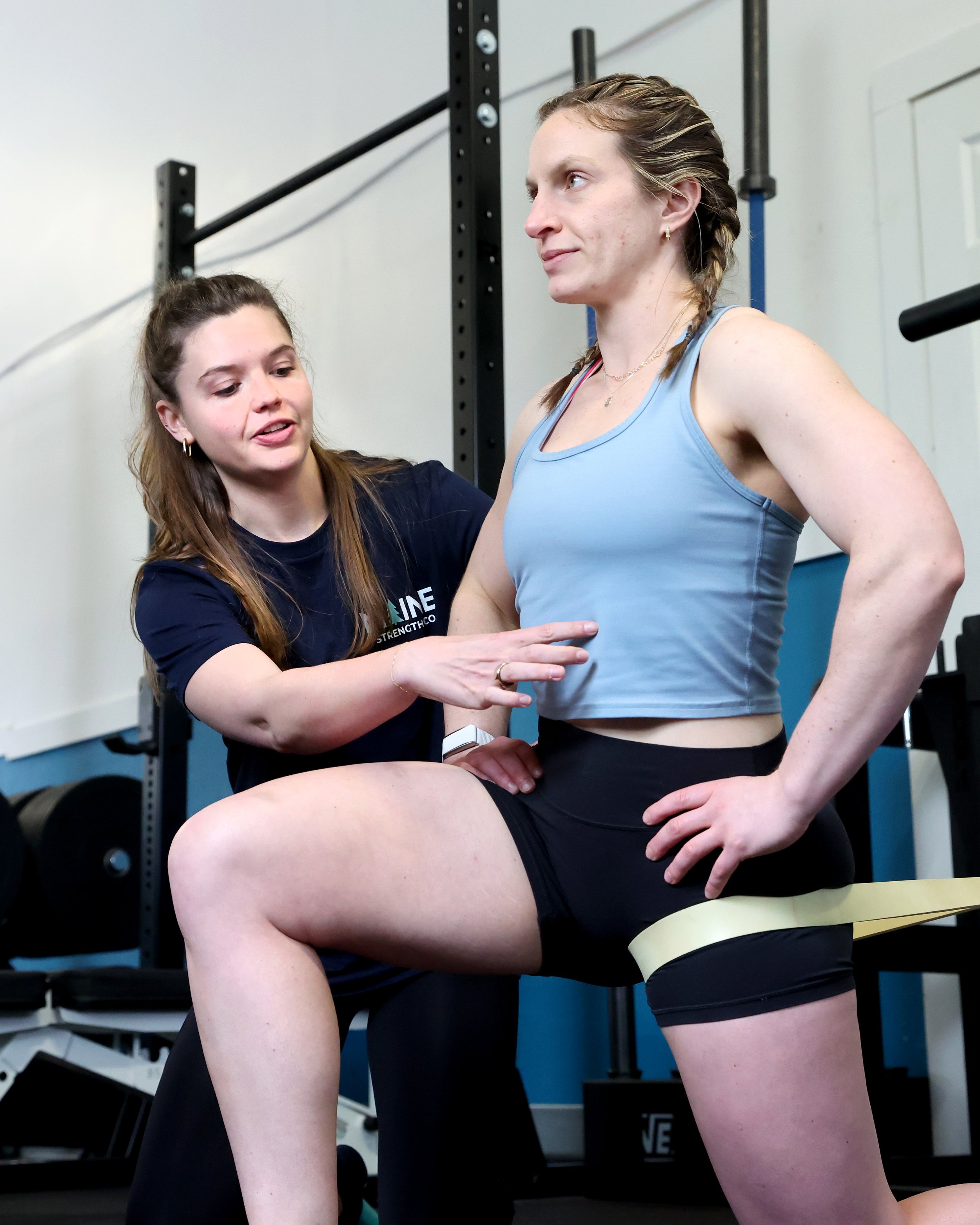
Performance Physical Therapy goes beyond rehab to help you create the performance system that helps you overcome current injuries, prevent future injuries, and understand your body on another level.
Recovery comes first. If you are recovering from an injury, we develop self-management strategies that go beyond our session so you can create a toolbox of ways you can promote recovery. This doesn’t simply mean that we will help you foam roll your problems away. We talk about the different pillars of recovery, including sleep, nutrition, mobility, and other internal or external tools you have at your disposal to improve your rate of recovery. These strategies carry forward into your long term performance plan.
Next comes loading. We don’t give you a cookie-cutter set of exercises. We take into consideration where you were before the injury, we assess your mechanics to determine the strength and coordination of the muscles involved, and we work with you to develop movement strategies to progress you back to where you were so we can progress further towards your goals. The strategy we take depends on your goals, your sport, and the extent of your injury.
Throughout our work together, we are creating your ideal performance plan together. That is, what training, recovery, nutrition, and ___ should look like to help you reach your goals and keep building towards your goals - current, and future.
Performance Coaching
Not currently rehabbing from an injury, but looking for a skilled coach who understands the body as a movement system and can help you better understand it while creating your training plan?
Small Group Training
Community is what started Maine Strength Co. in the first place. That is, small groups of individuals looking to train smart to support their goals. We aren’t going for the flashy 1 RM, we are looking at the arc of the next year, 5 years, 10 years, and training to feel incredible through them all. We view strength training as a practice, not simply a singular goal.
Classes have limited availability as we aim to keep the class experience small enough to promote connection and community between members, as well as for allowing for coaching to take place.
Current Class Schedule, led by Helen Harrod Clark, PT, DPT:
Monday + Wednesday Evening Strength + Conditioning @ 4:30-5:30pm and 5:30-6:30pm
Tuesday + Thursday Morning Strength @ 6:00am + 9:00am
Friday Morning Strength @ 9:00am
Saturday Morning Community Class @ 8:00am
Maine Strength Co. is the culmination of what I’ve wanted to create since I was 17 years old, and I’m excited to share it with you.
A note From Helen
Where It Started
I was recently listening to a podcast, originally recorded in 2017, where a question was asked: If you imagine life 10 years from now, what does it look like? What are you doing? What does it feel like? Rewind a decade, and as I listened to the podcast go on, I realized that 17 year old me would have been thrilled to see where we would end up.
Athleticism didn’t come easily for me, but I’m lucky to come from a family who encouraged movement as a part of a healthy lifestyle. Starting with T-Ball and community basketball (all coached by my father), and moving through seasons of field hockey, lacrosse, karate, a stint of cheerleading, and eventually landing on running on the cross country and track team. I remember one day, in elementary school, my father decided to go on a run and encouraged my older sister and me to join. At the time, I was young, and absolutely did not want to run, but opted, instead to skip with a jump rope for two miles…that would be easier, right?
Even after finally landing on running as my sport, I wasn’t a natural - despite my parents both being runners (they met each other on a run, after all). Actually, I was commonly the last place finisher. It wasn’t until a year into high school cross country and track, when a few of the seniors who I often ran with graduated, that I started to consider what it would take to improve in my sport.
By sheer exposure, I improved as a runner. That is, you become more efficient the more you practice your sport. This is the first stage of improvement, and, if you stick with any sport long enough, you are almost guaranteed to reach it. My physiology caught up, I no longer felt like I was gasping for air, I had developed the strength and endurance necessary to run my weekly mileage simply by running, and, by golly, I was really starting to enjoy it.
Then, that progress plateaued. And, not understanding what I know now about training, I fell into a common mistake made by runners, which can be summed up by one equation that is burned in my mind from AP Physics: F=ma. Force = Mass * Acceleration. Otherwise put: Acceleration = Force / Mass. That is, maintain the same level of acceleration and force but decrease your mass and watch your times drop. This worked well, until it didn’t.
Initially, my times improved drastically, and I managed to ride that wave for most of the XC season of my junior year. That was, until I found myself struggling to stay awake in classes, and finding it hard to summon the energy to get out of bed, let alone do a long run. At my worst, I was eating only 800 calories a day, and largely attribute my avoidance of injury to the incredible margin of error enjoyed by most young people.
At the same time, I was lucky enough to enter a gym environment, and it felt like a whole new world opened up. Suddenly, I was learning what muscles were involved in running, and how to specifically strengthen them. Food quickly became fuel when I stepped up to a light bar and could barely get it off the ground. The entire environment felt like a huge unlock for performance, and I started to wonder why everyone didn’t seem to know it existed.
We aren’t taught nearly enough about our bodies
I’m grateful that 10 years later, strength training isn’t nearly the secret it used to be. Many of us now see it as an important part of our exercise routine for any set of goals: sport, longevity (bone density, muscle density, continuing to do what you love), injury prevention, etc. But, it is only one important piece in a puzzle that includes training power, aerobic capacity, improving recovery and understanding the building blocks of longterm health and performance.
For over 10 years, I have lived in researching and learning about the innate performance levers we all have access to, and how to put them into practice. I received my Doctorate in Physical Therapy from Tufts University, which helped me improve my understanding of the movement system and how to recover from injury, while also preventing injury and promoting performance throughout the lifespan.
Now, I’m grateful to have opened Maine Strength Co, where I can offer interventions spanning from 1:1 rehab, to coaching, to group classes, and beyond. I’m excited to continue to expand my knowledge and my offerings to clients and be a contributor to the future of what human health and performance can feel like.
10 Years Later
Conditions We Treat
A short list of our services. Each is available as part of a plan of care or as a standalone offering for clients who want focused work on a specific area.
SI Joint Dysfunction
Sciatica
Low Back Pain without Radiculopathy
Low Back Pain
Tension Headaches
Cervical Radiculopathy
Postural Neck Pain + Chronic Tension
Neck Pain
Glute med tendinopathy
IT band syndrome
Hamstring tendinopathy
Hip labral tears
Hip Pain
Rotator cuff tendinopathy
Impingement
AC joint injuries
Shoulder pain
Runner's knee (patellofemoral pain syndrome)
Patellar tendinopathy
Meniscus injuries
Knee Pain
Tennis elbow (lateral epicondylitis)
Golfer's elbow (medial epicondylitis)
Elbow Pain
Plantar fasciitis
Achilles tendinopathy
Ankle sprains
Ankle/foot pain
Wrist/Hand Pain
De Quervain's tenosynovitis
Carpal Tunnel
Maine Strength Co. is located in Yarmouth, Maine. Our clients come from across the region — Freeport, Cumberland, Falmouth, Brunswick, Portland, North Yarmouth, Pownal, Durham, and beyond. Most drive 15-30 minutes for the kind of one-on-one performance care they can't find at a closer clinic.